LRRK2
If any of the terms on this page are unclear or you want to learn more about them click here!
LRRK2 (leucine-rich repeat kinase 2) is one of the most important genes linked to Parkinson’s disease. Mutations in LRRK2 can directly cause inherited Parkinson’s, and the same biological pathways also appear to play a role in more common, non-inherited cases.
LRRK2-associated Parkinson’s typically begins later in life and closely resembles typical Parkinson’s disease. A key distinction from some other Parkinson’s genes, such as PINK1 and Parkin, is that only one mutated copy of LRRK2 is needed to increase disease risk. In contrast, those other genes usually require mutations in both copies.

Normal function
LRRK2 encodes a large protein with multiple functional domains, including a kinase domain, which adds phosphate groups to other proteins to regulate their activity.
One of LRRK2’s main roles involves vesicle trafficking, the process by which cells move molecules between compartments using small membrane-bound sacs. This system is essential for delivering proteins, recycling cellular components, and maintaining organization within the cell.
LRRK2 also regulates a group of proteins called Rab GTPases. These act as molecular switches that control where vesicles go and when they fuse with other cellular compartments.
Through these functions, LRRK2 helps coordinate membrane trafficking (movement and organization of membranes inside the cell), lysosomal biology and overall cellular organization.
Mutation and effect
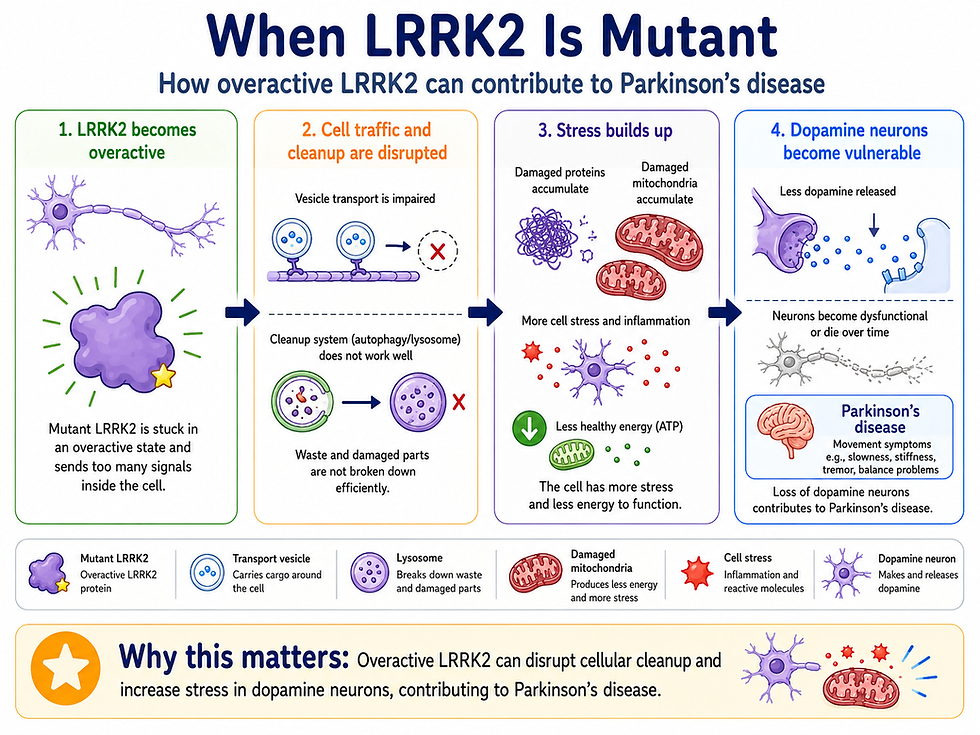
Many disease-causing LRRK2 mutations result in a toxic gain of function. This means the protein is still present but becomes overactive or behaves abnormally, rather than simply losing its function. In most cases, these mutations increase kinase activity, causing LRRK2 to add phosphate groups too frequently or to the wrong targets. This disrupts normal cellular signaling and trafficking processes. This distinction is important because it suggests a potential treatment strategy: instead of replacing LRRK2, therapies may work by reducing its excessive activity.
Key mechanisms involved
Abnormal LRRK2 activity affects several critical cellular systems including vesicle trafficking and lysosomal dysfunction. When vesicle trafficking is disrupted, different cells within the organelles may not communicate effectively. Lysosomes are part of the system the cell uses to process waste, so when it is not working properly damaged proteins, including alpha-synuclein, can accumulate.
Further, recent research shows that increased LRRK2 activity, as would be seen in a gain of function mutation, is associated with increased ROS and lipid peroxidation (when unstable molecules steal electrons from lipids/fats causing damage). ROS is heavily implicated in the development and progression of Parkinson’s disease, so LRRK2 may contribute to disease through multiple mechanisms.
Research focus
Current research on LRRK2 focuses on several key questions. Fully understanding the normal role of LRRK2, especially in vesicle trafficking, lysosomal function, and cell signaling is paramount. Another interesting question that has arisen is why some mutations in LRRK2 are more likely to cause disease than others. Finally, working to see if reducing LRRK2 activity safely slows disease progression either in the lab or in the clinic is a crucial step before bringing treatments to patients.
Implications for treatment
LRRK2 has become a major target for drug development. Because many mutations increase kinase activity, researchers are developing LRRK2 inhibitors, which are drugs designed to reduce this activity.
These therapies aim to restore more normal cellular signaling and trafficking. While they are still being studied and are not yet proven to slow disease progression, LRRK2 represents one of the strongest examples of how genetic discoveries can guide targeted treatments in Parkinson’s disease.
Research focus
Current research on LRRK2 focuses on several key questions. Fully understanding the normal role of LRRK2, especially in vesicle trafficking, lysosomal function, and cell signaling is paramount. Another interesting question that has arisen is why some mutations in LRRK2 are more likely to cause disease than others. Finally, working to see if reducing LRRK2 activity safely slows disease progression either in the lab or in the clinic is a crucial step before bringing treatments to patients.
Inheritance
LRRK2 is the single most known genetic cause of Parkinson's. Its main mutation is carried by up to about 2% of Parkinson's patients in the United States. It's dominant, so one changed copy can be enough to cause disease, and about 28% of carriers had developed Parkinson's by age 59, rising to about 74% by age 79 in one large study. Each child of a carrier has the standard 50/50 odds of inheriting the mutation, but LRRK2 has incomplete penetrance meaning not everyone with a mutated gene gets the disease.
Sources
- Wise, A., Raymond, D., & Saunders-Pullman, R. (2025). LRRK2-Related Parkinson Disease.
- Ito, G., Utsunomiya-Tate, N., & Okano, H. (2023). Overview of the Impact of Pathogenic LRRK2 Mutations in Parkinson’s Disease.
- Keeney, M. T., Rocha, E. M., Hoffman, E. K., et al. (2024). LRRK2 regulates production of reactive oxygen species in cell and animal models of Parkinson’s disease.
- Araki, M., Ito, G., & Tomita, T. (2018). Physiological and pathological functions of LRRK2: implications from substrate proteins.